Skip to content
Center for Digital Dignity

Public Scholarship

Publications, datasets and policy material produced by the centre and its collaborators.

Back to Real Love: PowerPoint Dating as a Response to Swipe Fatigue

Back to Real Love: PowerPoint Dating as a Response to Swipe Fatigue

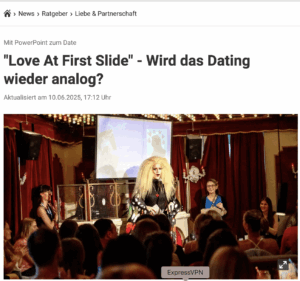
“Love At First Slide,” a new analog-inspired dating event in German cities, uses PowerPoint presentations created by friends to introduce singles in a more personalized setting instead of online dating sites like Tinder. The GMX article quoted Sahana Udupa, who observed that these shifts reflect a cultural reaction to swipe cultures of online dating, reflecting a growing desire for  real-world connections.

2025
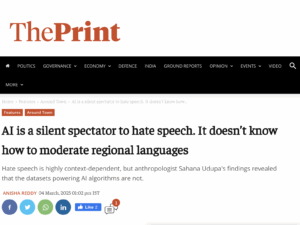
AI Fails to Detect Culturally Coded Hate Speech

AI Fails to Detect Culturally Coded Hate Speech

The Print published an article covering Sahana Udupa’s public lecture at NIAS Bengaluru in which she argued that AI systems are unable to detect culturally coded, linguistically diverse, and implicit derogatory expressions targeting vulnerable groups. Based on the findings of the AI4Dignity project, she called for collaborating coding practices in AI assisted content moderation.

2025

Podcast on Hate Speech and Online Misogyny

Podcast on Hate Speech and Online Misogyny

In a new podcast produced by the Bavarian Academy of Sciences, Matthias Quent, Andrea Abele-Brehm, Sahana Udupa, Christoph Neuberger, Anna Wegscheider, Marina Chernivsky, Max Czollek, Astrid Seville, Irma Trommer and Marina Weisband discuss the proliferation of interlinked forms of extreme speech. The podcast is hosted by Laura Robber and Ruth Zapf.

2023

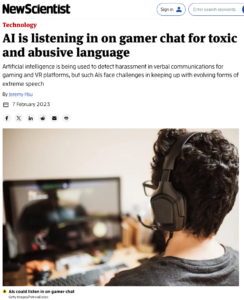
AI is listening

AI is listening

In the article, “AI is listening in on gamer chat for toxic and abusive language”, published in New Scientist, Jeremy Hsu cited Sahana Udupa’s research to highlight the difficulties of AI assisted content moderation.

2023

Interview for Watson.de on online misogyny

Interview for Watson.de on online misogyny

Sophia Sichtermann interviewed Sahana Udupa for Watson.de about hate influencers and online misogyny. Udupa highlighted the need for robust school and university education to counter regressive narratives masquerading as ‘knowledge’ on social media, especially how young online users are targeted by youthful conversational and narrative styles that hate influencers employ.

2022

Das langsame Vorgehen gegen Hassfluencer wie Andrew Tate

Das langsame Vorgehen gegen Hassfluencer wie Andrew Tate

In a news feature on social media hate influencers and misogynists online, Deutschlandfunk journalist Heike Wippenfürth spoke to Sahana Udupa about her research. Udupa pointed out that account suspensions will lead to hate influencers losing some momentum and audiences, but they will also go underground and find new ways.

2022

Brazilian television channel TV Cultura features AI4Dignity

Brazilian television channel TV Cultura features AI4Dignity

Brazilian television channel TV Cultura interviewed Sahana Udupa in their program on hate speech moderation and social media.  Udupa highlighted the limitations of AI-assisted content moderation and how culturally coded expressions tend to escape content filters. She discussed the findings of AI4Dignity, the European Research Council funded proof of concept project, which has created a collaborative process model for involving communities in bringing cultural and contextual nuance to machine learning models.

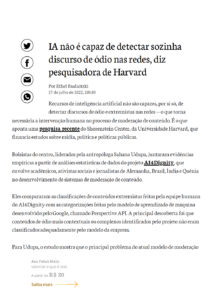
IA não é capaz de detectar sozinha discurso de ódio nas redes, diz pesquisadora de Harvard

IA não é capaz de detectar sozinha discurso de ódio nas redes, diz pesquisadora de Harvard

In an interview for the  Brazilian news organization, Aos Fatos, Sahana Udupa spoke with Ethel Rudnitzki to highlight the challenges of online content moderation especially during election times. The interview was published as part of a series of reports Aos Fatos has published in the runup to the presidential elections in the country. Aos Fatos focuses on fact-checking and investigates disinformation and misinformation networks on social media.

2022

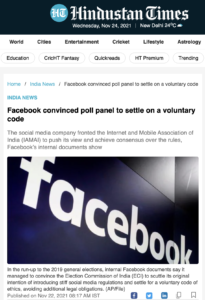
Facebook convinced poll panel to settle on a voluntary code

Facebook convinced poll panel to settle on a voluntary code

“The voluntary code that was drawn (up) during the 2019 general elections was weak and insufficient, not least because of the very manner in which it was created…Double distancing on the part of the social media companies—first from being direct parties and second from enforceable obligation—showed that the voluntary code arrangement was weak from its very inception.” Sahana Udupa quoted in the article.

2021

"At the heart of digital capitalism"

"At the heart of digital capitalism"

Are social media connecting us or tearing society apart? How do trolls, fake news, memes, and online misinformation impact upon politics today? The Gerda Henkel Stiftung interviews project PI Udupa on critical aspects of digital politics. Here is the link to the full interview.

2020

Showing 12 of 30 publications