Skip to content
Center for Digital Dignity

Resources

Publications, datasets and policy material produced by the centre and its collaborators.

UDUPA, S.(2026) PROMPT ETHNOGRAPHY: CRITICAL METHODOLOGY FOR GENERATIVE AI

UDUPA, S.(2026) PROMPT ETHNOGRAPHY: CRITICAL METHODOLOGY FOR GENERATIVE AI

This chapter develops “prompt ethnography” as a critical methodology to scrutinize generative AI. Prompt ethnography employs reflexive interactions with generative models and public controversies around model behaviors as empirical touchstones to draw inferences about why AI models say what they say about politically charged topics, and interrogate the larger structures of power that define the code, content and consternations undergirding model outputs. It is published in the Handbook of Anthropology and Artificial Intelligence (edited by Udupa S. & Hervik P., Edward Elgar)

UDUPA, S.(2026) PROMPT ETHNOGRAPHY: CRITICAL METHODOLOGY FOR GENERATIVE AI

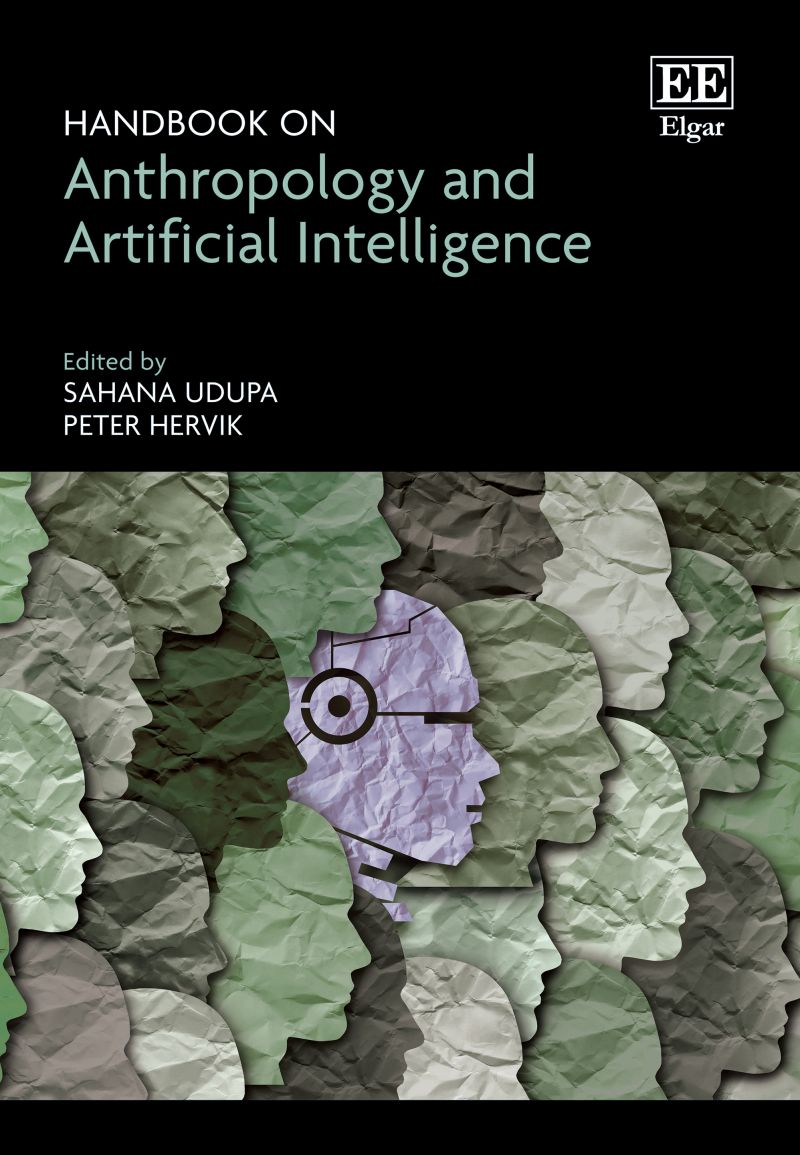
UDUPA, S. & HERVIK P. EDS. (2026) HANDBOOK ON ANTHROPOLOGY AND ARTIFICIAL INTELLIGENCE

Featuring 33 chapters and the editors’ introduction, this Handbook provides a groundbreaking collection of anthropological research on artificial intelligence (AI), examining how anthropology can help to comprehend and critique its development. Evaluating the limits, hopes and fears of AI, leading experts explore its influence as a sociocultural phenomenon rather than a discrete technological system.

UDUPA, S. (2025) DEEP EXTREME SPEECH: INTIMATE NETWORKS FOR INFLAMED RHETORIC ON WHATSAPP

UDUPA, S. (2025) DEEP EXTREME SPEECH: INTIMATE NETWORKS FOR INFLAMED RHETORIC ON WHATSAPP

In this chapter, Sahana Udupa suggests that WhatsApp’s unique role in disinformation and vitriolic ecosystems in contexts of divisive politics lies not as much in the architectural features of encryption but around particular clusters of social relations it enters, entrenches and reshapes. The chapter develops the concept of “deep extreme speech”. It centers community allegiances in distribution logics, framing extreme content as part of the everyday.

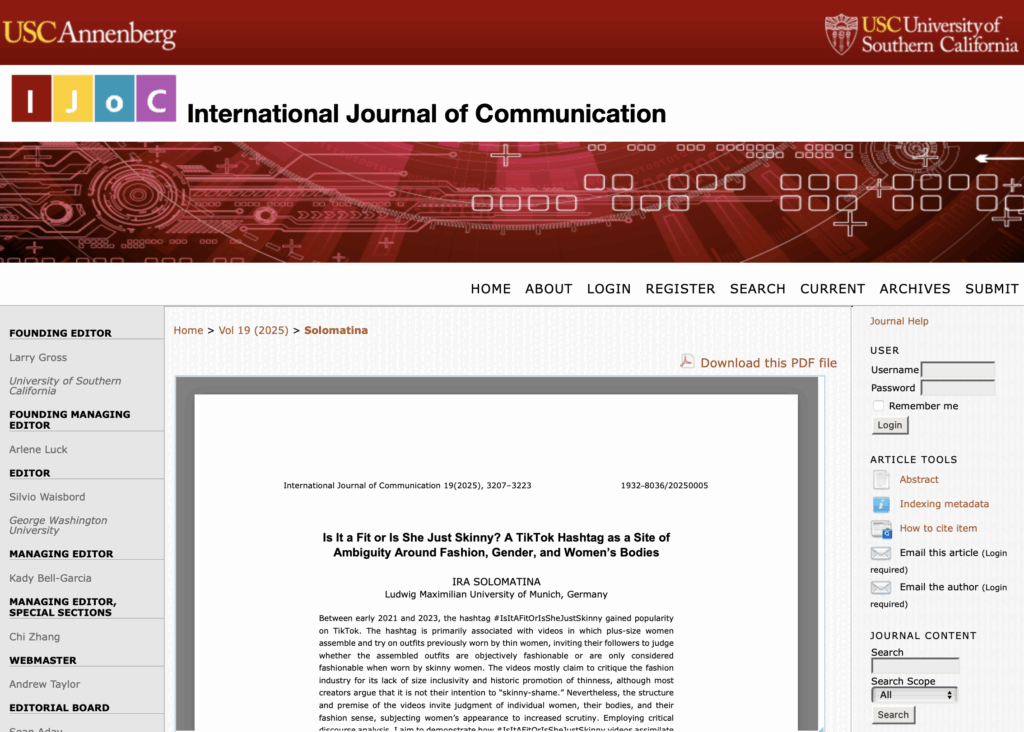
SOLOMATINA, I. (2025) IS IT A FIT OR IS SHE JUST SKINNY? A TIKTOK HASHTAG AS A SITE OF AMBIGUITY AROUND FASHION, GENDER, AND WOMEN’S BODIES

SOLOMATINA, I. (2025) IS IT A FIT OR IS SHE JUST SKINNY? A TIKTOK HASHTAG AS A SITE OF AMBIGUITY AROUND FASHION, GENDER, AND WOMEN’S BODIES

In this article, Ira Solomatina analyzes the TikTok hashtag #IsItAFitOrIsSheJustSkinny, where plus-size women recreate outfits worn by thin women to question whether style is judged by fashion sense or body size. Through critical discourse analysis, she reveals how these videos, while critiquing size exclusivity, ultimately channel women’s dissatisfaction into postfeminist ideals of aesthetic labor and empowerment through fashion.

MWAURA, J. (2025) WHO OWNS THE NEWS? THE POLITICAL ECONOMY OF AI JOURNALISM IN AFRICA

MWAURA, J. (2025) WHO OWNS THE NEWS? THE POLITICAL ECONOMY OF AI JOURNALISM IN AFRICA

In this forthcoming chapter, Job Mwaura investigates the political economy shaping the integration of generative AI into African newsrooms, focusing on questions of technological ownership, access, and agency. By situating AI journalism within broader power structures, the analysis reveals how global tech monopolies and local infrastructural disparities influence who gets to produce, control, and benefit from AI-generated news. The chapter calls for a critical rethinking of media sovereignty and public trust in an increasingly automated information landscape.

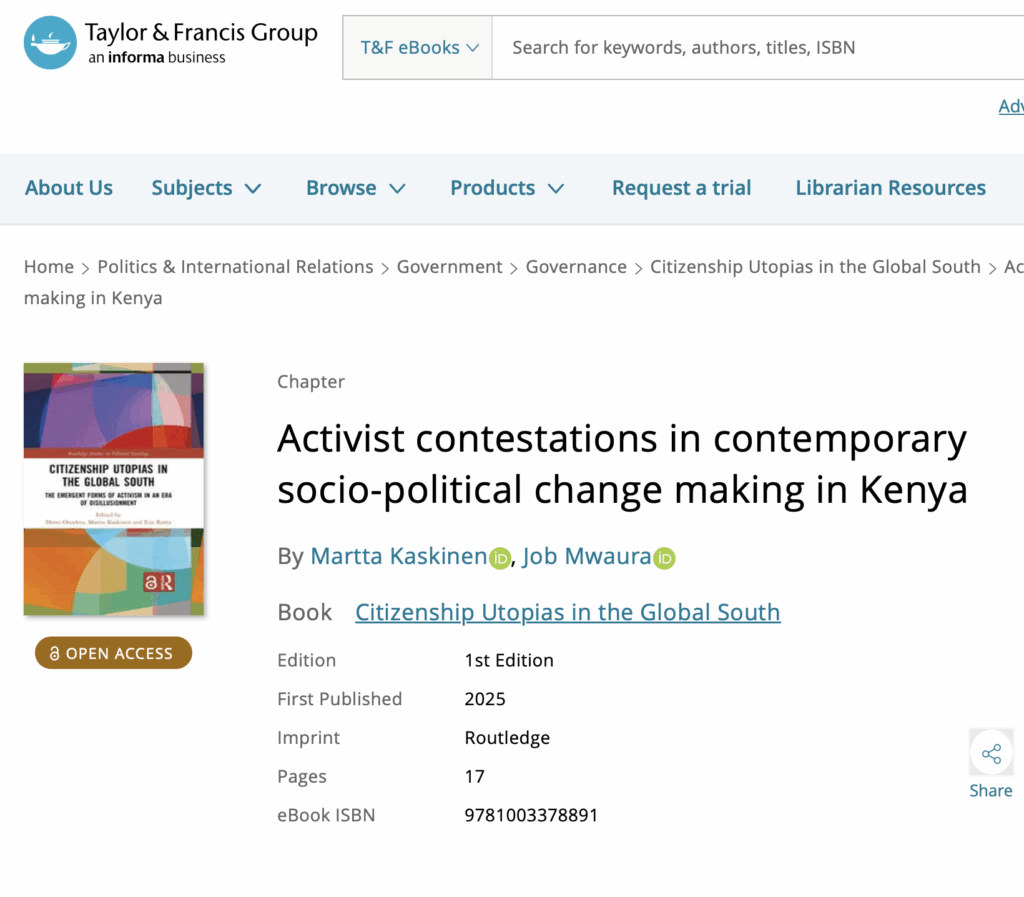
KASKINEN, M. & MWAURA, J. (2025) ACTIVIST CONTESTATIONS IN CONTEMPORARY SOCIO-POLITICAL CHANGE MAKING IN KENYA

KASKINEN, M. & MWAURA, J. (2025) ACTIVIST CONTESTATIONS IN CONTEMPORARY SOCIO-POLITICAL CHANGE MAKING IN KENYA

This chapter explores the shifting terrain of activism in Kenya, where declining donor support and state hostility have narrowed the space for civil society while disillusionment grows among younger generations. Drawing on extensive fieldwork, the authors examine how community-based justice centres have emerged as critical spaces for activism, despite deep-seated tensions and mistrust among activist groups. By analyzing both collaboration and conflict—particularly through the lens of the Saba Saba March for Our Lives—the chapter argues that contestation itself is a defining feature of a resilient and evolving activist ecosystem.

UDUPA, S. (2025) DEEP EXTREME SPEECH: INTIMATE NETWORKS FOR INFLAMED RHETORIC ON WHATSAPP

UDUPA, S. & WASSERMAN, H. (2025) WHATSAPP IN THE WORLD: DISINFORMATION, ENCRYPTION, AND EXTREME SPEECH

WhatsApp in the World (New York University Press) offers a global analysis of the vastly popular encrypted instant messaging service. Rather than taking the technical feature of “encryption” at face value, the volume proposes the conceptual framework of “lived encryptions” to highlight the different, often contradictory, formations around encrypted messaging, as evidenced in the way the promised confidentiality of encrypted messaging is upturned completely when surveilling states seize the phones from suspected dissenters to download the data, or how seemingly closed group communication is channelized to “broadcast” top-down political messages. Click here to download the book.

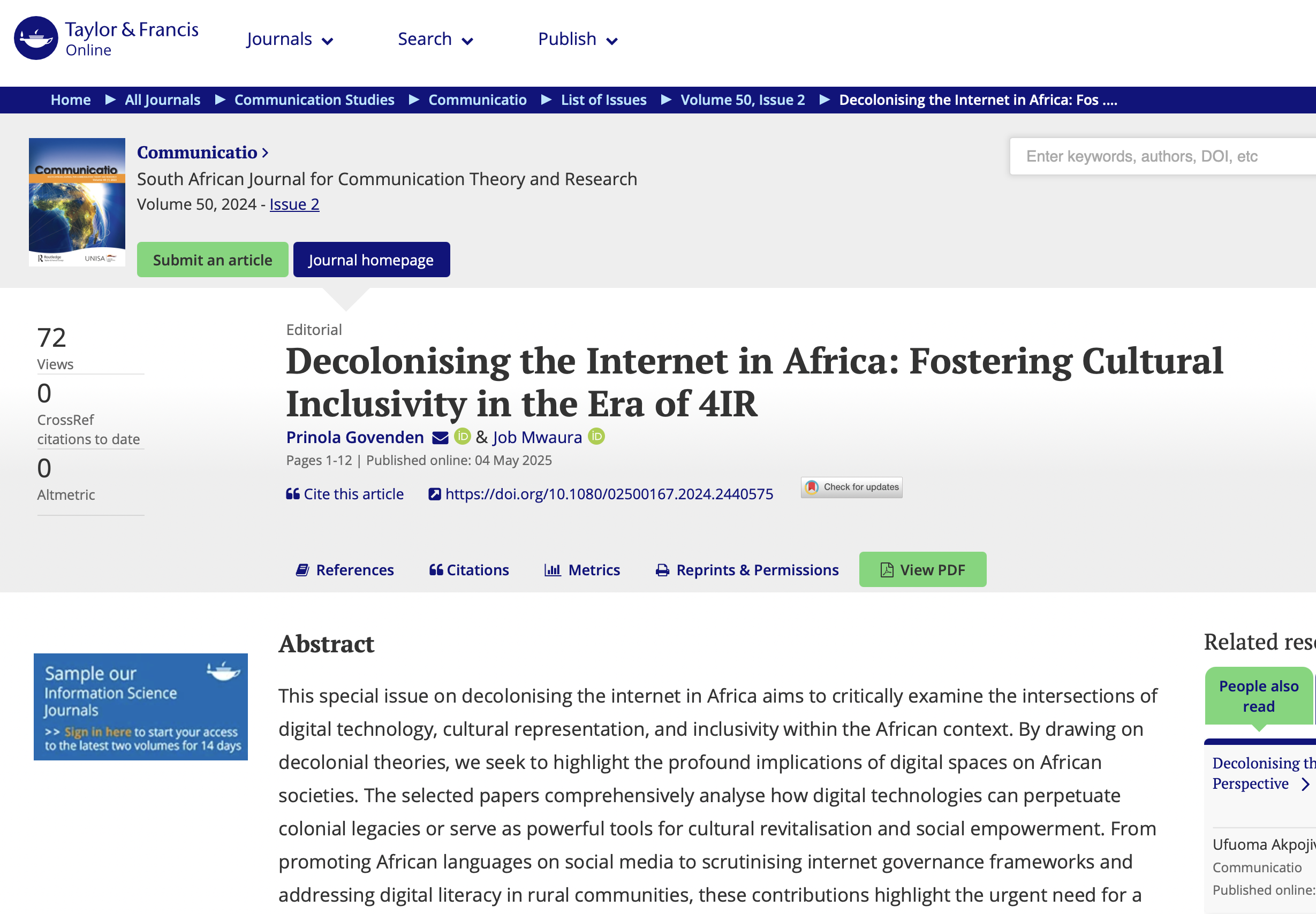
GOVENDEN, P. & MWAURA, J. (2024) DECOLONISING THE INTERNET IN AFRICA: FOSTERING CULTURAL INCLUSIVITY IN THE ERA OF 4IR

GOVENDEN, P. & MWAURA, J. (2024) DECOLONISING THE INTERNET IN AFRICA: FOSTERING CULTURAL INCLUSIVITY IN THE ERA OF 4IR

In this contribution to a special issue on decolonising the internet, the authors explore how digital technologies in Africa can either reinforce colonial legacies or become tools for cultural inclusion and empowerment. Grounded in decolonial theory, the article highlights the importance of African languages, knowledge systems, and governance models in shaping a more equitable digital landscape amid the Fourth Industrial Revolution. By centering African epistemologies, the piece offers both critical insights and actionable pathways for building a culturally inclusive internet that reflects and serves the continent’s diverse realities.

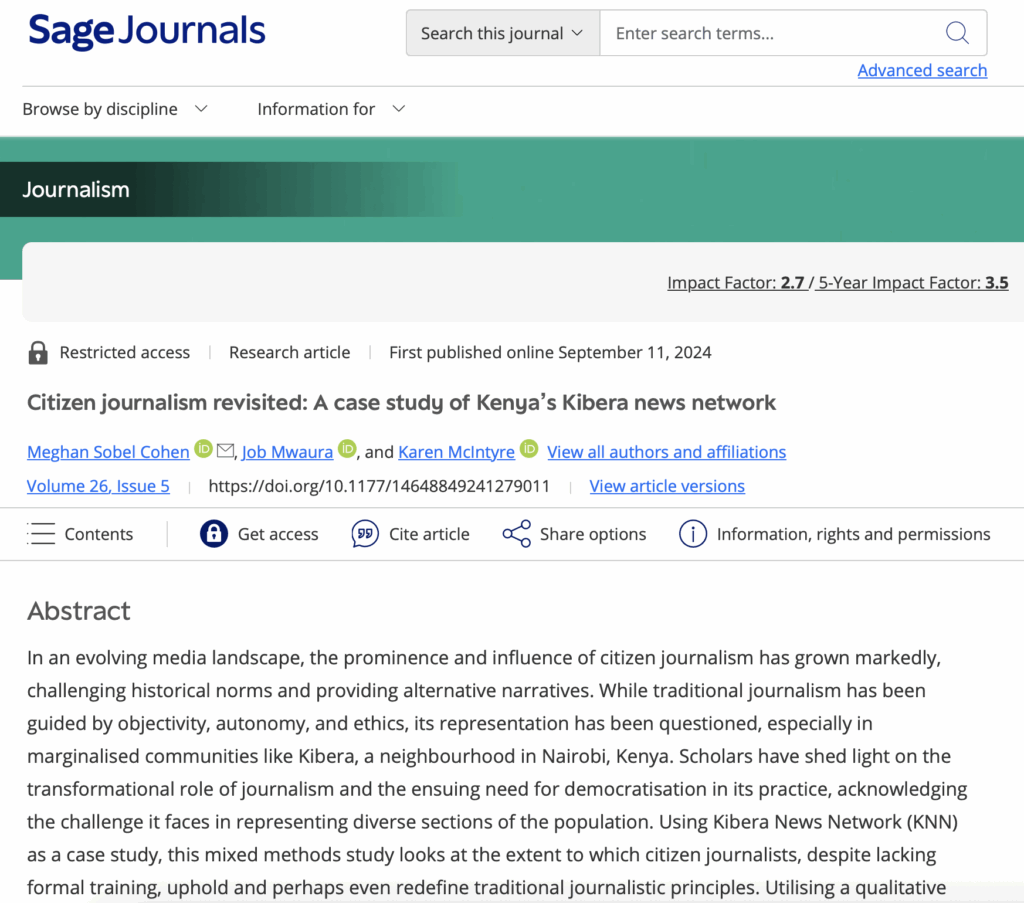
COHEN, M.S., MWAURA, J. & MCINTYRE, K. (2024) A CASE STUDY OF KENYA’S KIBERA NEWS NETWORK

COHEN, M.S., MWAURA, J. & MCINTYRE, K. (2024) A CASE STUDY OF KENYA’S KIBERA NEWS NETWORK

This study examines the Kibera News Network as a powerful case of citizen journalism emerging from one of Nairobi’s most marginalized communities. Through video analysis and interviews, the authors reveal how local journalists—despite lacking formal training—demonstrate strong ethical standards, narrative autonomy, and a deep sense of civic responsibility rooted in community belonging. Their work not only challenges dominant media portrayals but also fosters social cohesion and participatory engagement from within.

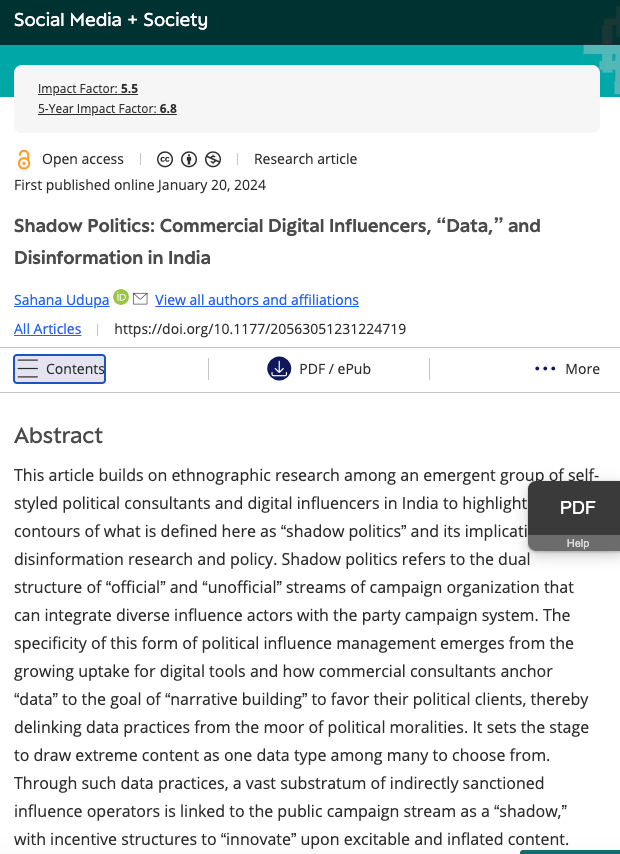
UDUPA, S. (2024) SHADOW POLITICS: COMMERCIAL DIGITAL INFLUENCERS, DATA AND DISINFORMATION IN INDIA

UDUPA, S. (2024) SHADOW POLITICS: COMMERCIAL DIGITAL INFLUENCERS, DATA AND DISINFORMATION IN INDIA

This article builds on ethnographic research among an emergent group of self-styled political consultants and digital influencers in India to highlight the contours of what is defined here as “shadow politics” and its implications for disinformation research and policy. Shadow politics refers to the dual structure of “official” and “unofficial” streams of campaign organization that can integrate diverse influence actors with the party campaign system. Through  data practices, a vast substratum of indirectly sanctioned influence operators is linked to the public campaign stream as a “shadow,” with incentive structures to “innovate” upon excitable and inflated content.

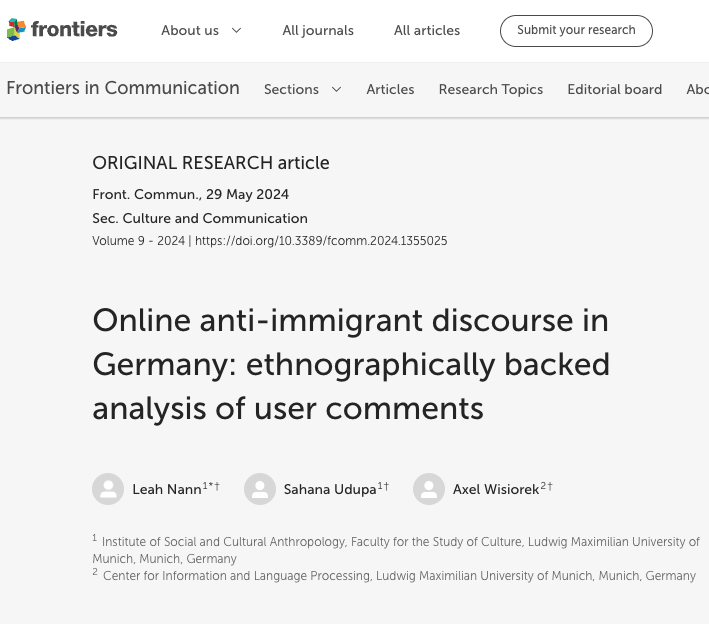
NANN, L., UDUPA, S. & WISIOREK, A. (2024) ONLINE ANTI-IMMIGRANT DISCOURSE IN GERMANY

NANN, L., UDUPA, S. & WISIOREK, A. (2024) ONLINE ANTI-IMMIGRANT DISCOURSE IN GERMANY

In this article published by Frontiers in Communication, Leah Nann, Sahana Udupa and Axel Wisiorek investigate discourse- and language-specific features of online anti-immigrant extreme speech in Germany. The article shows how direct forms of racism intertwine with argumentative forms of antagonism and playful word games within anti-immigrant discourses. It also examines the emergence of a non-standard language variety in and through anti-immigrant discourse, which helps the discourse community maintain group identity.

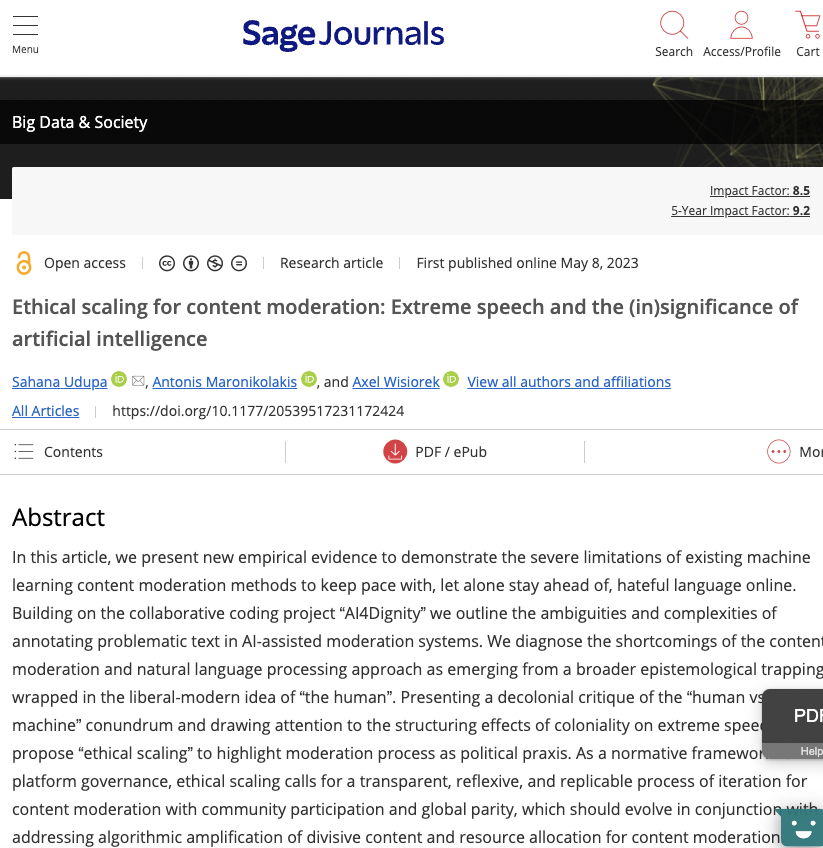
UDUPA, S., MARONIKOLAKIS, A. & WISIOREK, A. (2023) ETHICAL SCALING FOR CONTENT MODERATION: EXTREME SPEECH AND THE (IN)SIGNIFICANCE OF ARTIFICIAL INTELLIGENCE

UDUPA, S., MARONIKOLAKIS, A. & WISIOREK, A. (2023) ETHICAL SCALING FOR CONTENT MODERATION: EXTREME SPEECH AND THE (IN)SIGNIFICANCE OF ARTIFICIAL INTELLIGENCE

In this article published by Big Data & Society, we present new empirical evidence to demonstrate the severe limitations of existing machine learning content moderation methods to keep pace with, let alone stay ahead of, hateful language online. Presenting a decolonial critique of the “human vs machine” conundrum and drawing attention to the structuring effects of coloniality on extreme speech, we propose “ethical scaling” to highlight moderation process as political praxis.

Showing 12 of 82 publications